99% of Hair Growth Supplements Are Just A Fad.
But This Might Be The Best Thing I've Seen In Decades As A Certified Trichologist…
A skeptical, no-nonsense take from a scalp specialist who's watched a decade of gimmick ingredients and hollow marketing promises come and go, and the one formula that's actually made me stop and pay attention.

 Verified
 At a Glance
 Most "hair growth" supplements are built around one trending ingredient and a good marketing budget — not a credible strategy for real results.
- Hair loss is showing up earlier and more often in women's 30s and 40s than it used to, often driven by GLP-1 medications, menopause, postpartum depletion, chronic stress, and a nutrient-thin modern diet.
- WEEM is one of the only formulas I've seen that actually addresses the full nutrient picture instead of chasing a trend.
I'll say this upfront, because I think it needs saying: I'm tired of hair supplements. I've spent close to a decade in this field, and I have watched ingredient after ingredient get crowned the "next big thing" — collagen, marine peptides, ashwagandha, you name it — get a glossy influencer campaign, and then quietly disappear when the results don't hold up. Most of what's sold in this category is a trend with a supplement label stapled to it, not a real answer for the women sitting in my chair asking why their hair is so much thinner than it used to be.
So when I say a formula actually made me stop and pay attention, I don't say that lightly. But WEEM did something none of the others could.
Why hair loss is happening earlier than it used to...
Here's what I'm actually seeing in practice, and it's worth being honest about: the women coming to me with noticeable thinning are, on average, younger than they were when I started. That's not a marketing line, it's a pattern I've watched build over the last several years, and there are real, identifiable reasons behind it.
 Chronic Stress
Sustained cortisol exposure pushes hair follicles into their resting phase early — a pattern called telogen effluvium. The always-on nature of modern work and life means many women live in a low-grade version of this for years.
 GLP-1 Medications
Rapid weight loss and reduced eating starve the follicle of protein and micronutrients. Shedding typically shows up 2–3 months after starting the medication — one of the most common causes I'm seeing in practice.
 Menopause
Falling estrogen shortens hair's growth phase and thins the strand itself. What's changed is how depleted many women's baseline nutrient stores already are by the time they reach this stage.
 Postpartum Depletion
The hormone crash after birth causes a delayed shedding wave, usually peaking three to four months later, on top of a body already using its nutrient reserves for recovery and breastfeeding.
 Nutrient-Thin Modern Diet
Modern diets are calorie-dense and often micronutrient-poor. Zinc, B-vitamins, and biotin deficiencies show up more often than most people expect, even in women who consider themselves eating well.

None of this is a single dramatic cause. It's a slow stacking of ordinary modern-life pressures on a system that needs more nutritional support than it's getting — which is exactly why a single-ingredient "trend" supplement is almost never enough.
Why I don't trust most of what's on the shelf...
I want to be direct about this, because I think the supplement industry has earned some skepticism. A lot of hair vitamins are built around one flashy ingredient at a dose too low to matter, wrapped in packaging that promises results the formula was never designed to deliver. I've seen women spend months and real money on products that were never going to work for their specific situation, because the formula wasn't built to address the actual nutrient gap behind their shedding.
That's the bar WEEM had to clear before I'd put my name anywhere near it.
What I actually look for in a formula
After a decade of watching products come and go, I've narrowed it down to a short list. If a formula doesn't clear these, I don't recommend it — no matter how well it's marketed:
- 1A dose that's actually high enough to matter. A lot of labels list an ingredient at a fraction of the amount studies actually use, just to put it on the label.
- 2Full nutrient coverage, not one hero ingredient. Hair loss is almost never caused by a single deficiency, so a formula built around just one trending ingredient is never going to address the real problem.
- 3No proprietary blends hiding weak doses. If a label won't tell you exactly how much of each ingredient you're getting, that's usually because the amount wouldn't impress you.
- 4A format people will actually stick with. The best formula in the world doesn't work if it sits in a cabinet after week three.
What WEEM actually does differently
WEEM's biotin dose is 5,000 mcg per serving — double what you'll find in a typical drugstore biotin gummy — paired with a full spread of Vitamins A, C, E, B5, B6, B12, and zinc. That combination matters because the stress, GLP-1, menopause, postpartum, and diet-driven depletion covered above rarely comes down to one missing nutrient. A formula that only leans on biotin is only answering half the question.
It checks the rest of my list too: every batch is third-party tested, and there are no proprietary blends hiding weak doses behind a vague label. What's on the ingredient panel is what's actually in the gummy, at doses that are worth taking seriously.
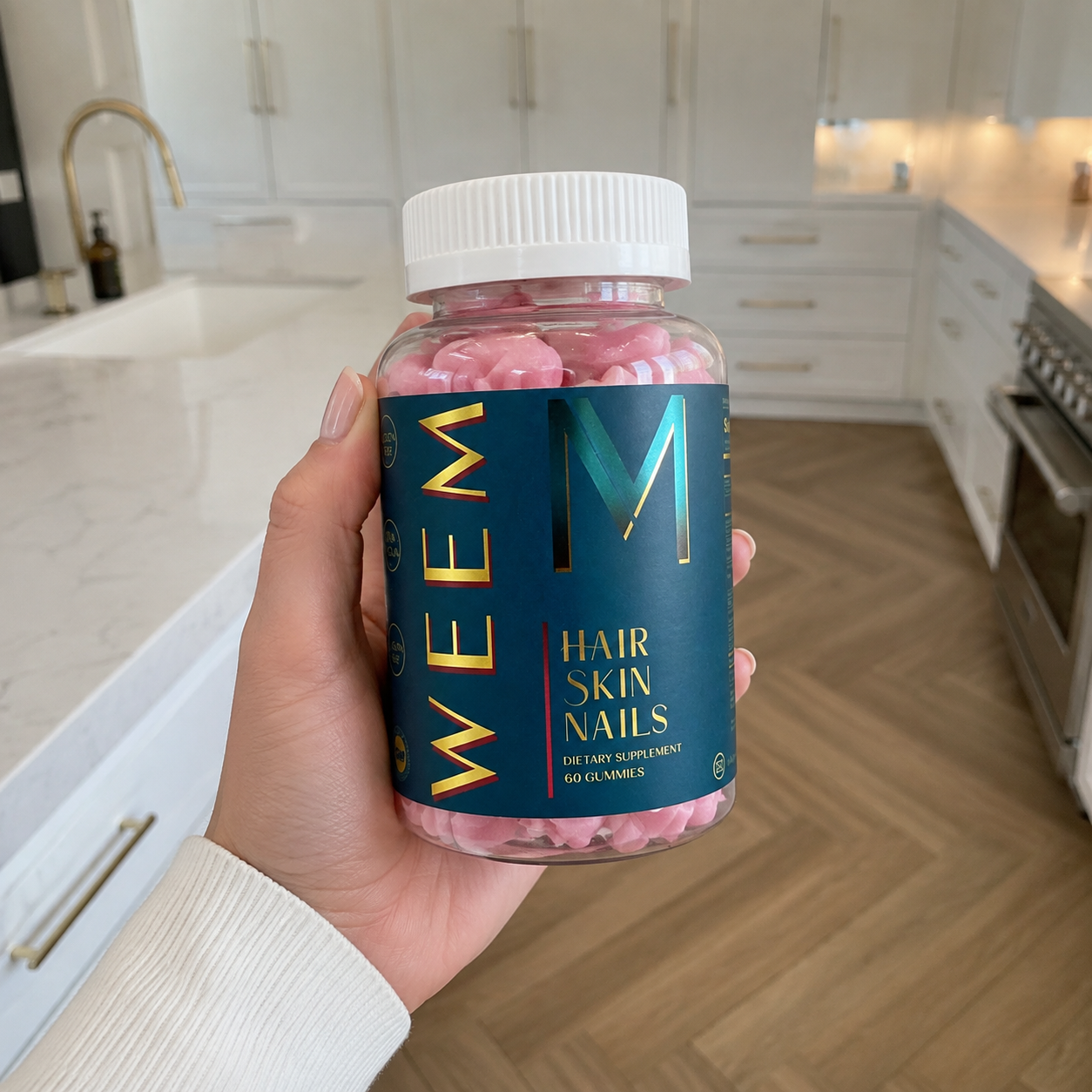
It's also simple to actually stick with: two gummies a day, no fish gelatin, nothing that's difficult to take on a sensitive stomach, which matters if you're also managing GLP-1-related nausea. Over 500,000 people are currently taking WEEM's Hair, Skin & Nails gummies every month, which tells me I'm not the only one who's landed on this formula after looking closely at what's actually in it. And it's backed by a full money-back guarantee if you don't see results, which tells you something about how the people behind it feel about their own hair growth formula.

5,000 mcg
Biotin per serving

500K+
Monthly users

100%
Money-back guarantee
How I'd actually recommend taking it

Take with a meal
Gentler on the stomach, and fat-soluble vitamins A and E absorb better alongside food.

Give it 8–12 weeks
Hair growth cycles move slowly — meaningful change takes consistent daily use over this full window.

Pair with protein
Hair is built from protein — a great supplement can't fully compensate for a diet that's lacking the raw materials.
A few common questions

Most people notice less shedding and improved texture somewhere between 8 and 12 weeks of consistent daily use. Hair grows in cycles, so patience matters more than most people expect going in.
For most healthy adults, yes — biotin is water-soluble, so your body clears what it doesn't use. It can interfere with certain lab tests, thyroid panels in particular, so mention it to your doctor before routine bloodwork.
I recommend it specifically for this reason — GLP-1-related shedding is one of the most common patterns I'm seeing right now, and it's driven by exactly the kind of nutrient gap this formula is built to address. As always, mention any supplement to your prescribing doctor.
 My honest take
I don't say this about most things in this category, because most things in this category don't deserve it: WEEM is the first hair supplement in a long time that made me actually reconsider what I recommend to my own clients. It isn't chasing a trending ingredient — it's addressing the actual, layered nutrient depletion behind why so many women are seeing this earlier than they used to. That's a harder thing to market than a single hero ingredient, but it's the thing that actually works.
If you're dealing with hair thinning tied to stress, a GLP-1 medication, menopause, postpartum recovery, or just the cumulative weight of modern life catching up with your body, this is where I'd start.
 Scalp Specialist's Pick
The most complete formula, at a price that makes consistency realistic
WEEM covers the full nutrient panel your hair is actually missing — not just biotin — in two vegan gummies a day, backed by a full money-back guarantee.
See WEEM Hair, Skin & Nails
 VeganTwo gummies a dayMoney-back guarantee
About the Author
Emily DeNard
Certified Trichologist & Scalp Specialist · Owner, Emunah Beauty
Emily DeNard is a Certified Trichologist and Scalp Specialist, and the owner of Emunah Beauty, her private practice based in Pittsburgh, PA. She holds certification through the U.S. Trichology Institute and is a member of the American Medical Certification Association. With more than a decade in practice, she has worked with thousands of women navigating hormonal and medication-related hair loss, and has personally evaluated hundreds of hair, skin, and nail supplements on the market.